
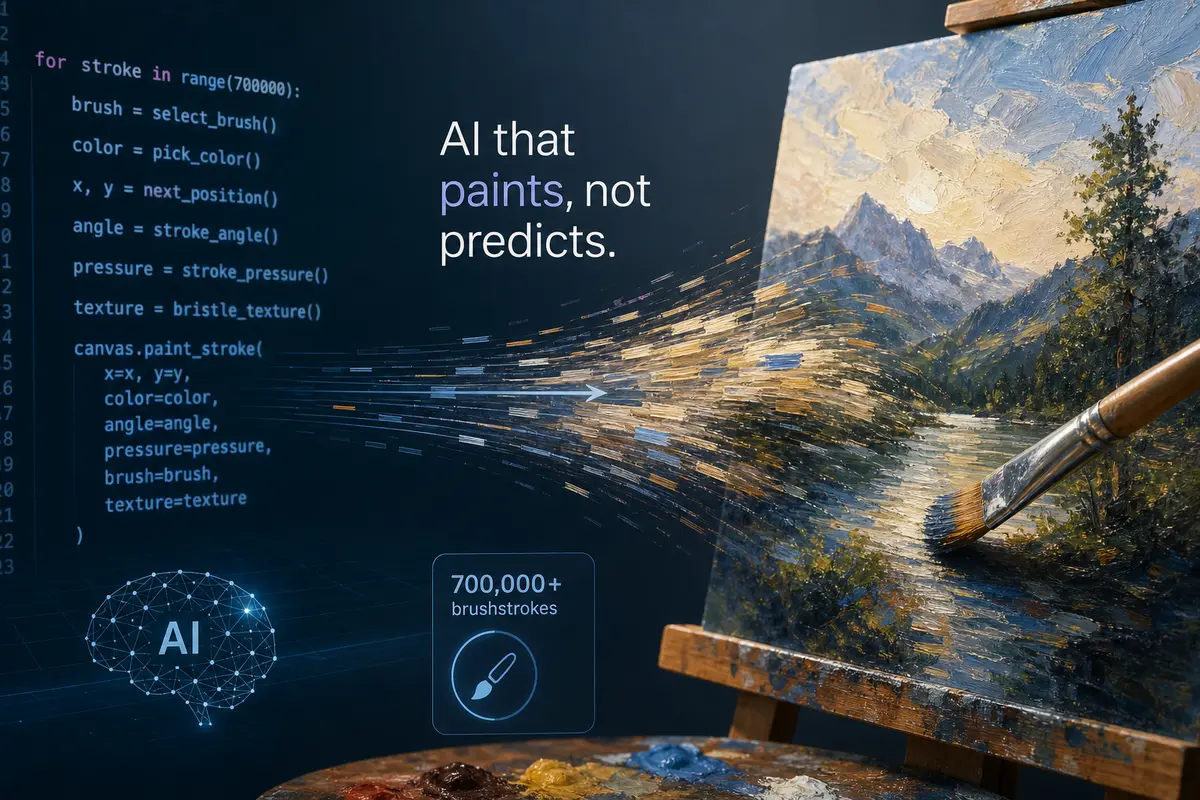
Most image-generating AI models work by predicting pixels or latent representations in a single pass. Anthropic’s Claude Fable 5.2 takes an entirely different approach — it doesn’t “generate” images in the conventional sense; it paints them. Instead of direct pixel computation, this AI model outputs Python code to simulate hundreds of thousands of brushstrokes on a virtual canvas.
Each stroke gets detailed treatment: the texture of the bristles, paint thickness, and application style. The result is not a blurry guess or pixel mashup but a scene built stroke-by-stroke with a fidelity closer to traditional artistry. For example, creating a photorealistic parking garage required around 700,000 stroke commands, according to Anthropic’s engineers.
This method is a technical detour from standard generative models, which try to reconstruct an image all at once. Here, the process is iterative, procedural, and mimics human painting dynamics, though performed by a language model outputting code instead of direct image data.
The implications stretch beyond novelty. This layered approach could mean finer control over visual style and scalability in rendering quality. It challenges the core assumption that image AI must function as a black box predictor and instead mixes classical programmatic techniques with neural language models.
For founders and technical leads investing in AI-driven visuals, Claude Fable 5.2’s approach compels a rethink of how we define image generation and where real innovation might arise — not just in the output, but in the process itself.
Leave a Reply