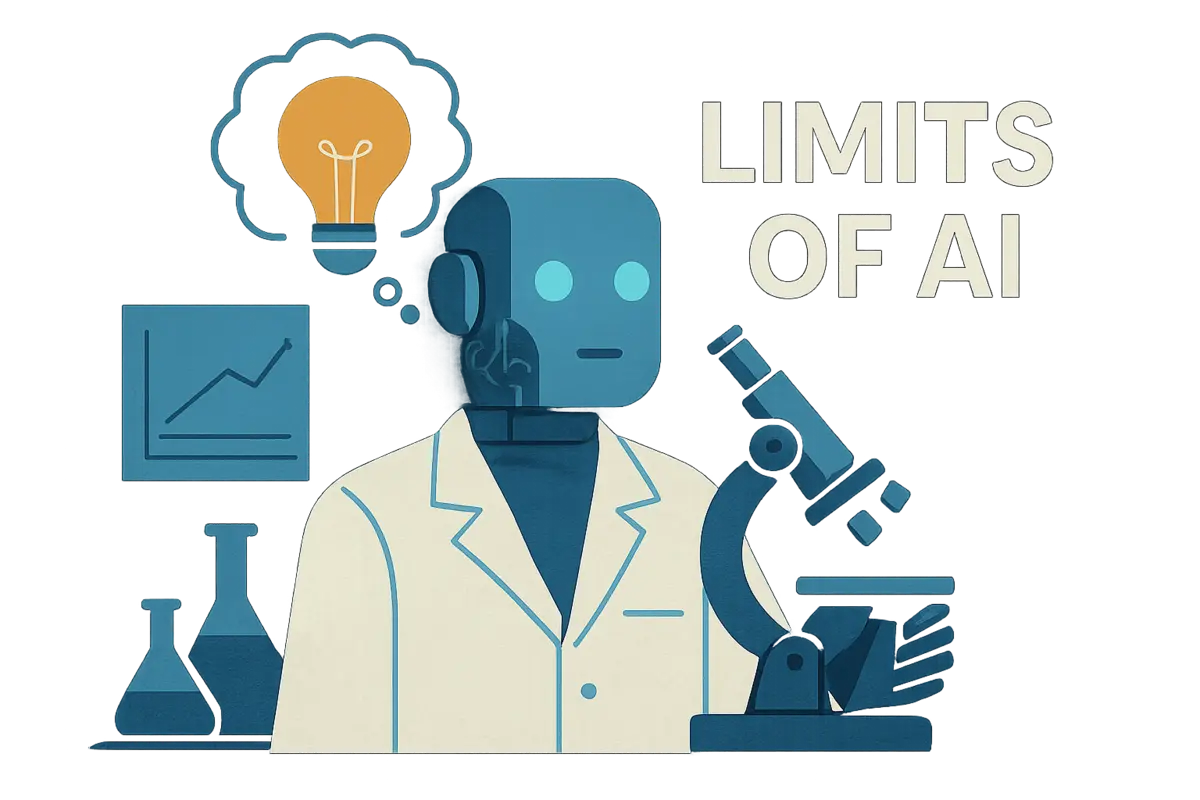
AI systems like GPT-5.6 Sol and Claude Fable 5 are often touted as capable of conducting autonomous research, but the reality is more sobering. Independent studies reveal these models can run experiments but fail to achieve meaningful scientific self-criticism or original thinking. Even at their best, performance metrics like Sol’s are barely 15 percent of a human researcher’s level—and that is on tasks rooted in well-established methods, not genuine innovation.
The core limitation lies in the lack of critical reasoning. These AI agents do not possess the ability to interrogate their own results or to challenge underlying assumptions. This is not a mere technical hiccup but a fundamental constraint of current large language model-based architectures. They excel at pattern matching and recombination of existing knowledge, but creativity and skepticism remain elusive.
What this means for companies looking to these technologies for breakthrough research or risk reduction is clear: the hype around autonomous AI scientists is misleading. These models can assist by automating routine data processing or hypothesis generation within a human-led framework, but they cannot replace expert intuition or judgment.
For anyone considering integrating AI into research pipelines, the takeaway is to treat these agents as advanced tools rather than independent investigators. Expect augmentation, not autonomy.
Leave a Reply