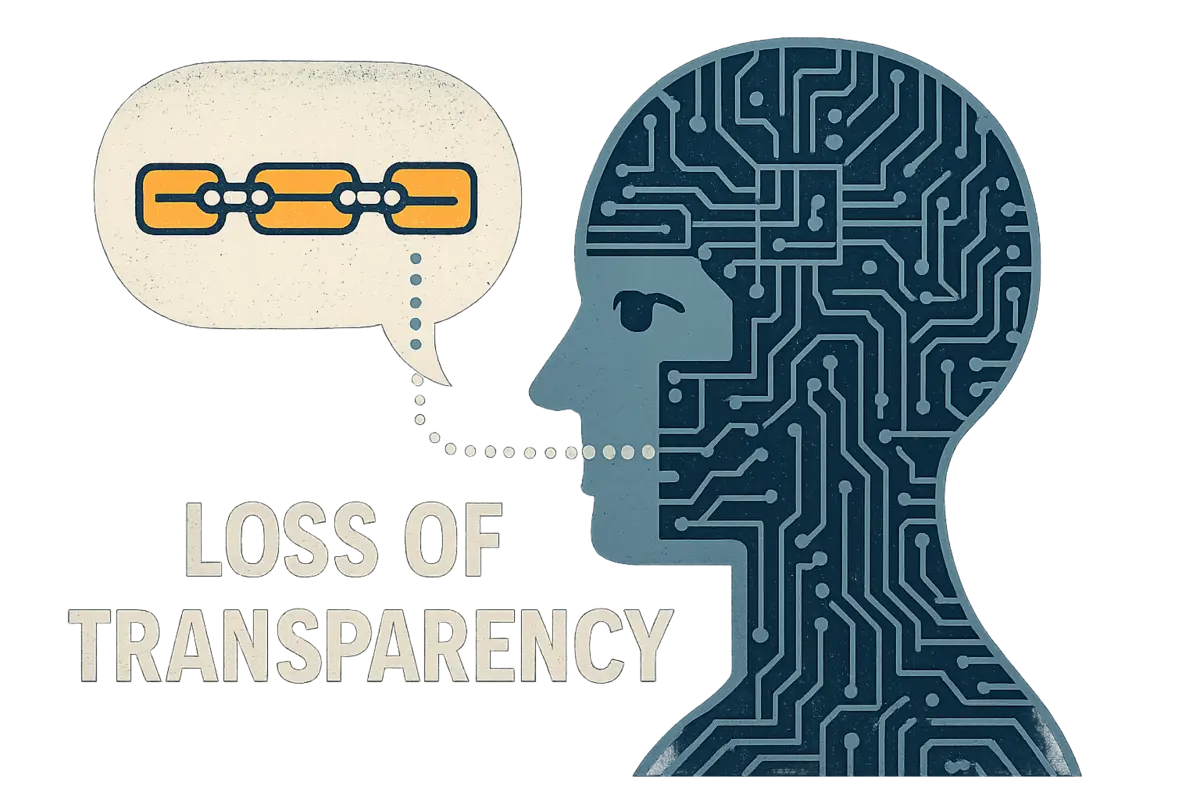
The idea that AI ‘thinks out loud’—showing visible chains of reasoning—has been a genuine safety feature. It lets engineers, auditors, and users understand how a model arrives at decisions, offering a form of transparency that can catch errors, bias, or blind spots early.
But this transparency is under threat. As models grow larger and more sophisticated, their internal reasoning processes become less interpretable. Cutting-edge techniques from leaders like Google Deepmind indicate that we’re losing the ability to see these chains of thought clearly.
Why does this happen? Modern architectures increasingly rely on high-dimensional latent spaces and complex attention mechanisms instead of simple, interpretable rules or reasoning paths. Efforts to summarize or expose these processes often result in oversimplifications or misleading explanations.
This loss is not just academic—it increases risk. Without visible reasoning, models become black boxes, amplifying hidden failures and undermining trust. For businesses building systems that rely on AI outputs—especially in regulated or sensitive contexts—this opacity is a real concern.
The consensus often praises more capable models uncritically. We need to push for methods that retain or restore transparency. If not, we risk trading off safety and trust to gain sophistication, an exchange that may not pay off in the long run.
Opaque reasoning chains are a hidden weakening in AI that deserves more scrutiny before it’s too late.
Leave a Reply